Ventilation for all-electric kitchens: you can still burn a sausage
More kitchens are going all-electric, and many operators assume the ventilation can shrink with the gas. In our experience it cannot. Here is what changes, what does not, and where electric kitchens catch people out.
The shift to electric
We have seen a steady move towards all-electric kitchens for several years. New buildings are increasingly built without a gas supply as the push towards net zero and heat pumps continues. Independent and high-street restaurants are the ones most often looking at electric, or at solid fuel, as the alternative to gas. Older schools and institutions often want to go electric but simply do not have the electrical capacity.
It is not all one way. With electricity prices rising, we have also seen some larger kitchens swing back towards gas to cut their electrical demand and their bills.
The myth: electric needs less ventilation
Part of the appeal of going electric is a belief that the ventilation requirement drops. From experience, we know that is not true. Take away the gas and you remove combustion products, but you do not remove grease, smoke, steam or heat.
You might not have gas, but you can still burn a sausage. A good chef won't, but you still produce the same grease and the same smoke.
Some electric equipment actually needs more extract than its gas equivalent. Electric vaporising char grills, for example, need a higher air volume than a gas or standard electric char grill. And cooking fumes contain harmful compounds, some of them carcinogenic, whatever the heat source. The right ventilation matters just as much in an electric kitchen.
Induction: less heat is not always good news
Induction is a great piece of equipment. It works brilliantly and puts far less heat into the kitchen. But that cuts both ways for ventilation.
Canopy extract relies on the heat from the cooking to carry steam, smoke and grease up into the filters. With induction there is much less rising heat, so the plume gets less help reaching the canopy. The lack of heat is working against you, not for you.
If you go purely by the standard figures for induction appliances, the volumes can come out too low, especially under a whole suite of induction equipment. That is where industry experience comes in, together with a specific extract flow rate (SEFR) calculation, to make sure the volumes are high enough to capture the fumes. Induction can still create smoke and plumes of steam.
Don't underestimate the impact of all-induction. The volume can come out too low. It might solve a problem with the duct route, but it causes a bigger one when steam and smoke drift round the building.
Steam: the forgotten load
Some of the hardest-working electric appliances produce huge amounts of steam:
- Bratt pans, boiling pans and multi-function cooking centres can boil off large volumes of water. Get the extract wrong and the kitchen quickly turns into a rainforest.
- Combi ovens release bursts of steam every time the door opens.
- Rack and flight dishwashers need good ventilation even when they have built-in heat recovery, to prevent mould and excess humidity.
No gas, no interlock: what protects the kitchen?
With no gas there is no gas interlock, and in reality nothing else is required to prove the fans are running in an all-electric kitchen. Interlocking the cooking equipment to the ventilation would be good practice, but operators are often reluctant, because they do not want equipment going offline if a fan stops.
Two things do apply. Modern fire suppression systems are interlocked so that the energy supply to the appliances, electric as well as gas, is cut when the system discharges. And with a recirculation unit, the electric appliances should always be interlocked with the unit, so they cannot be used unless it is running. Be aware that plenty of recirculation units on the market have no provision for this. Solid fuel is different again, with its own safety monitoring, covered in our gas interlock guide.
Recirculation: a last resort, but a good one
All-electric cooking opens up recirculation: a self-contained unit that filters the cooking fumes and returns the air to the kitchen, with no duct to roof. We treat it as a last resort, but it is a great solution on a genuinely difficult site.
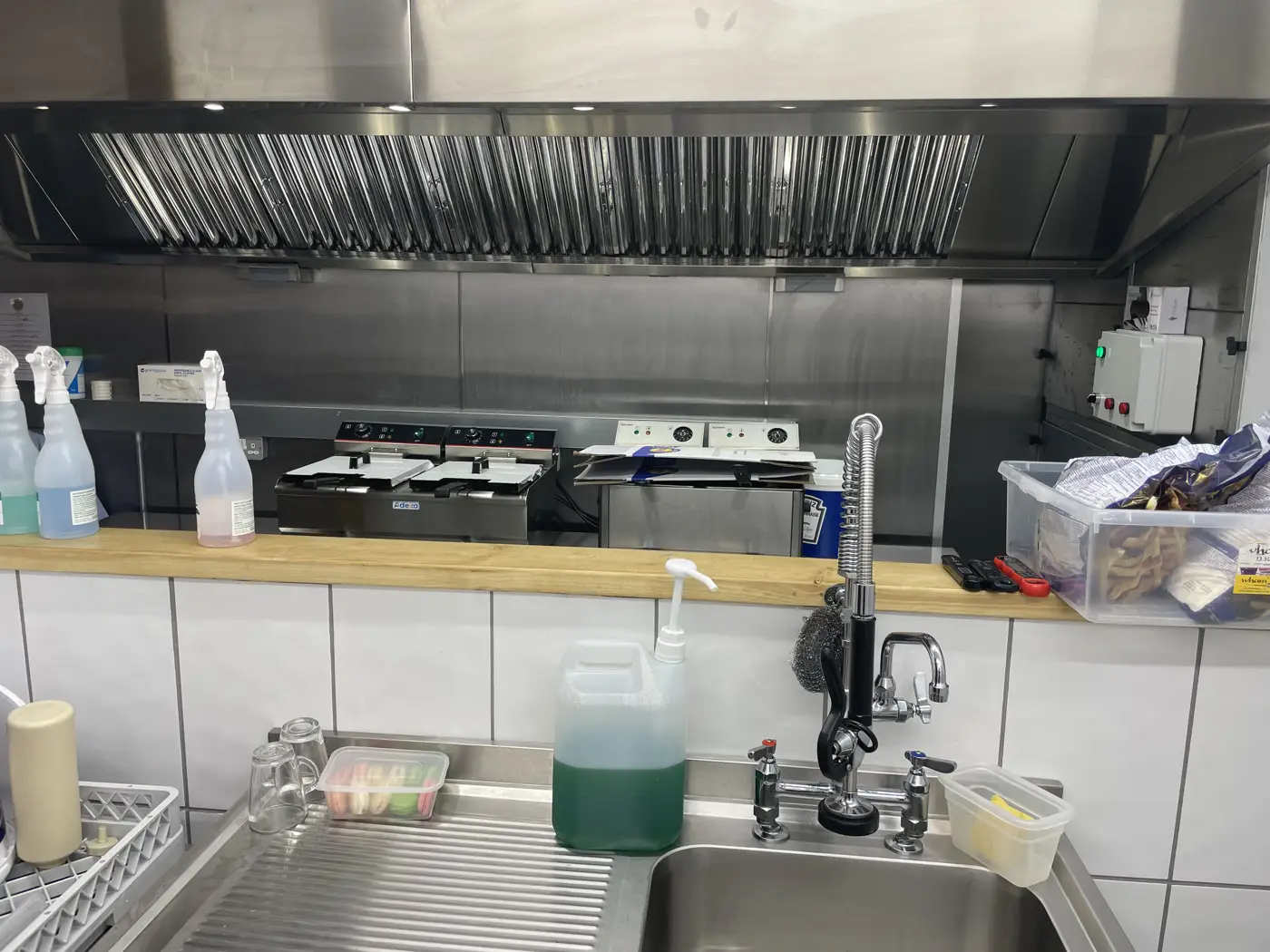
There are plenty of sites around the country where conventional extract is very difficult, but there is still a good business to be had. For small cafés and low- to medium-output kitchens, a recirculation unit can be perfect. At Flora in London, the client had no permission to make any alteration to the building. Because all the equipment was electric, a recirculation unit made the kitchen possible.
The problems start with high-output equipment: char grills, bratt pans and boiling pans. There is too much smoke and humidity for a recirculation unit to cope with, and the running costs rarely stack up.
What operators misunderstand about recirculation
The common surprises are the heat it returns to the kitchen, the cost and frequency of filter changes, and above all the need for background ventilation.
Why do I need background ventilation? That's the whole point of a recirculation unit. Not at all: it ventilates your cooking equipment. It doesn't ventilate your space.
A recirculation unit does not remove odours from the prep area, provide fresh air for staff, or give the room an air change, and building regulations still require general ventilation. DW/172 asks for supply air; our view is that these spaces should have both mechanical extract and supply.
Demand-controlled ventilation
Demand-controlled ventilation varies the fan speed with the cooking load. It is most useful in larger kitchens with several canopies, where some areas are idle for long periods. A bulk-cooking prep area that is not used during service, for example, can be turned down or off.
Applying variable volume to a single canopy is less straightforward. Turning the airflow down slows the air through the baffle filters, and they become less efficient at removing grease. There is a place for it in the market, but sit down with a reputable supplier first and work out the real savings and payback.
Heat recovery from kitchen extract
Recovering heat from kitchen extract can make sense in the UK, with one big condition: the air must be very well filtered before it reaches the heat recovery unit. Otherwise the heat exchanger acts as a very efficient grease filter and clogs quickly. With a decent set of ESPs and good filtration, it works.
It pays back where the kitchen runs long hours and gets up to temperature. A restaurant running from six in the morning until two at night is a strong candidate. A school kitchen, or an all-induction kitchen with little waste heat, is unlikely to recover the investment in a reasonable time.
Power supply: where the ventilation gets squeezed
Going all-electric regularly runs into electrical capacity limits. The fans themselves draw relatively little compared with the cooking equipment. The pressure comes from heating the supply air: with the air volumes involved, an electric heater battery is typically three-phase, and its current draw climbs quickly. Heat pumps and DX coils are more efficient, but their condensers add load too.
Because the cooking equipment is what earns the money, the ventilation is often where the budget for capacity gets cut. That is worth knowing early: untempered supply air means a kitchen that follows the weather, and it is the most common reason we find supply fans switched off in winter.
Electric does not mean cheap
We regularly sit down with clients who assumed electric meant a small, cheap system, and explain what good ventilation does for their operation in the long run. It is not just about combustion products.
Staff have to be your number one priority. It's not realistic to keep changing and retraining staff. It costs more in the long run. Do it once, do it properly.
Advice for operators and consultants
Think seriously about what you are cooking, and make sure the ventilation rates suit it. Do not underestimate steaming equipment, vaporising grills, or the effect of an all-induction line on capture.
Use a ventilation company that specialises in kitchens. Specialist kitchen ventilation companies understand how the catering equipment under the canopy works and how the kitchen operates, not just how to move air. Any good one will be happy to help and advise.
This guide is general information to help you plan. It is not a substitute for design of a specific system. Standards are revised from time to time, so always check the current edition.
Frequently asked questions
Do all-electric kitchens need less ventilation?
Not necessarily. Removing gas removes combustion products, but grease, smoke, steam and heat remain. Some electric appliances, such as vaporising char grills, need more extract than their gas equivalents.
Does induction cooking reduce extract requirements?
Induction puts less heat into the room, but that also means less rising heat to carry steam and smoke into the canopy. Extract sized purely on standard induction figures can be too low, so it needs checking with experience and a specific extract flow rate (SEFR) calculation.
Is a gas interlock needed in an all-electric kitchen?
No. There is no gas to isolate. Interlocking the appliances to the fans is good practice but not usually required. With a recirculation unit, the electric appliances should be interlocked with the unit.
When is a recirculation unit suitable?
For low- to medium-output electric cooking on sites where ducting to roof is impossible or not permitted. It is not suitable for high-output equipment such as char grills, bratt pans and boiling pans, and the space still needs background ventilation.
Is heat recovery from kitchen extract worthwhile?
It can be, for kitchens with long operating hours, provided the extract is very well filtered first, for example with ESPs. For short-hours kitchens such as schools, the payback is usually too long.
Why does supply air heating cause electrical capacity problems?
Electric heater batteries for kitchen supply air are typically three-phase and draw a lot of current at the volumes involved. Heat pumps and DX systems are more efficient, but still add load.
Related
Need this applied to your kitchen?
Send us the details and we will design a system to suit.