Gas interlock requirements for commercial kitchens
If your kitchen cooks with gas under mechanical ventilation, you need a working gas interlock. This guide covers what it does, who is responsible, and what we find on real sites.
What a gas interlock does
A gas interlock stops gas reaching the cooking equipment unless the ventilation is proved to be running. The extract, and the supply air where fitted, are designed around the appliances below. The interlock monitors that system. Only when it is running within its commissioned limits does the interlock power the gas solenoid valve and let gas through to the appliances. If the ventilation fails, the gas shuts off.
Kitchens are often enclosed spaces with no windows or other natural ventilation. Without extract, the by-products of combustion, including carbon monoxide, build up quickly. The interlock standards are about those combustion products, but good ventilation does more than that: cooking fumes themselves contain harmful compounds, some of them carcinogenic, and they need removing properly too.
A gas interlock is a life safety system. Health and safety is everybody's responsibility, and that includes everyone who touches the project.
Who is responsible?
Everyone involved has a part to play:
- The operator must keep the kitchen safe for staff, and arrange the annual gas safety inspection.
- The gas engineer installs the gas supply and appliances to current standards and checks the interlock works. They can only check it when the operator calls them in.
- The ventilation contractor, in our case, advises the customer correctly and makes sure the right ventilation and interlock equipment is installed and ready for the gas engineer to sign off.
The consequence of getting it wrong is immediate. A Gas Safe engineer who finds an unsafe installation can turn off or disconnect the appliances and leave them off until it is put right. For an operator, that means a kitchen that cannot cook and lost income.
What triggers the requirement on an existing kitchen?
New commercial kitchens with gas appliances have needed an interlock for more than 20 years. On an existing kitchen, the requirement is commonly triggered by:
- Replacing gas appliances. DW/172 indicates this applies even to like-for-like replacements.
- Changes to the ventilation system, such as a new canopy or new fans. Our view is that any change to the ventilation should bring the system up to the current standard.
- A refurbishment of the kitchen
Your gas engineer will confirm what applies to your installation under BS 6173.
How the system proves the ventilation is running
There are two common methods:
- Airflow (pressure) switches sense the air moving in the duct. They can become clogged with grease if the system is not maintained.
- Current sensing monitors the fan motor. Once the normal current draw is set, a blockage, a drop in airflow or a broken impeller changes it. Some engineers prefer it because it covers more failure modes.
Both have pros and cons. Set up and maintained properly, both are equally reliable.
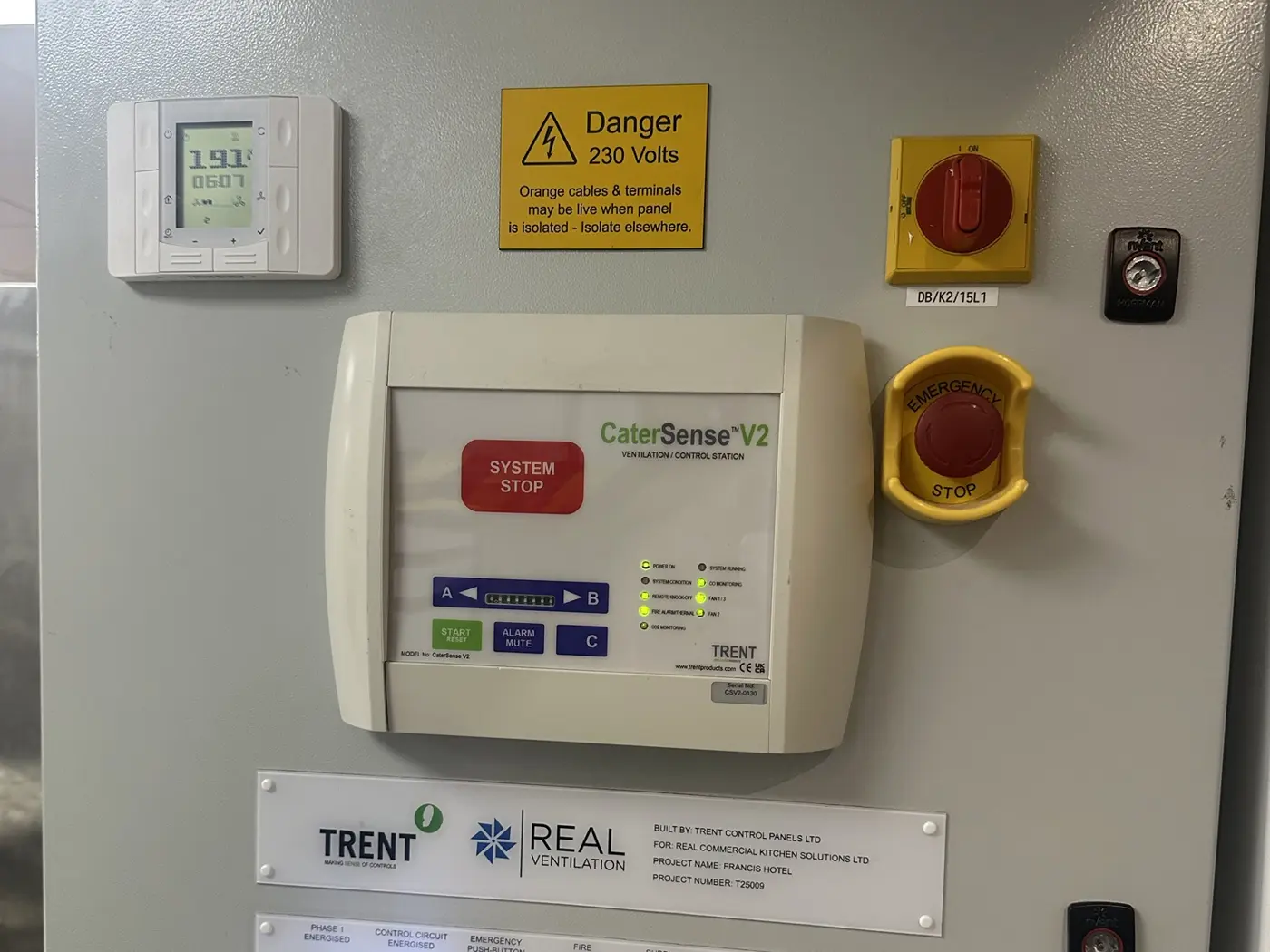
CO2 monitoring
We include CO2 monitoring as standard practice, and many gas engineers now insist on it. It adds a second layer of protection by monitoring air quality directly, and it is particularly worthwhile in enclosed kitchens and basements.
Fan speed controls and the interlock
Fan speed controls are mainly there to fine-tune the system at commissioning. Sometimes they also give staff some control. With gas appliances, the interlock is set to the minimum commissioned airflow, so staff can turn the system up but not below that minimum.
With electric equipment, the system can be turned down to match the cooking load at the time. There is a catch: as airflow drops, baffle filters remove grease less efficiently. It is a fine balance between how much control to give kitchen staff and keeping controls for commissioning only.
Who does what
Interlock panels are supplied by specialist manufacturers. We often use S&S Northern, among others. The site electrician typically wires the panel, and we complete the commissioning so the interlock is set to the system's commissioned airflows.
What we find in older kitchens
It is now rare to find a gas kitchen with no interlock at all. More common problems are:
- Panels that monitor the extract only, not the supply air
- Panels linked only to an emergency stop, which cut the gas but do not monitor airflow at all, especially in larger, older kitchens
- Supply air linked out because the kitchen was cold in winter, usually where no heater was ever fitted
- Interlocks that were never commissioned properly, with pressure switches set so airflow can be turned down below safe limits
In our experience, the problem is far more often incorrect commissioning than bad installation.
When a gas engineer fails a kitchen
When a gas engineer issues an "at risk" notice, the operator usually calls their catering equipment supplier, who calls us. Sometimes the fix is modest: an old system with an underpowered fan can be upgraded and adjusted to suit. Other times it needs a full upgrade. We have seen systems dating back to the 1970s that did not comply at all, either because gas checks had not been done or because the problem only came to light with an equipment change.
Retrofits range from a fan change to a complete new extract or supply air system. Out-of-hours work is possible, depending on the size of the job and whether noise is acceptable at night. In a residential area, nobody wants hammering at midnight.
Solid fuel: no gas valve to shut
Charcoal and wood appliances have no gas supply to isolate, so a gas interlock does not apply. Instead, we supply a solid fuel safety system:
- CO2 and carbon monoxide monitoring in the kitchen
- In-duct temperature monitoring, where specified
- All linked to EC or inverter-controlled fans
If any reading rises beyond safe limits, the fans ramp up, at any time of day or night. For example, if coals are left in an oven overnight with the fans off and carbon monoxide starts to build, the system starts the fans, clears the space and keeps running until readings are back within safe limits.
Common misunderstandings
Most operators now understand that they need an interlock. What surprises them is that a gas engineer can disconnect their equipment and walk away if the installation is dangerous.
Another is the idea of an "interlock-ready" canopy. The canopy itself is not part of the interlock. It is the fans, their power supply or the airflow that is monitored, so the phrase does not really mean anything. Ask instead whether the ventilation system has been designed, supplied and commissioned to work with an interlock.
Taking over an existing kitchen?
Check that the gas interlock and ventilation controls work before you commit. Fixing a faulty interlock can easily run to a couple of thousand pounds.
If you are taking over an existing kitchen, get a condition survey of the systems done as part of the lease negotiation.
A survey highlights anything that needs fixing, so you can negotiate remedial works with the landlord before you sign rather than discover them when the gas engineer visits.
This guide is general information to help you plan. It is not a substitute for design of a specific system. Standards are revised from time to time, so always check the current edition.
Frequently asked questions
Does my commercial kitchen need a gas interlock?
If you cook with gas under a mechanical ventilation system, yes. New kitchens have required one for over 20 years, and replacing gas appliances or altering the ventilation on an existing kitchen will normally trigger the requirement.
What happens if my kitchen has no working interlock?
A Gas Safe engineer can turn off or disconnect the gas appliances until the installation is made safe, which can stop the kitchen trading.
Is a pressure switch or current sensing better?
Both work well if set up and maintained properly. Current sensing monitors the fan motor and can detect blockages or a broken impeller; pressure switches sense airflow directly but can clog with grease if neglected.
Do I need CO2 monitoring as well?
Many gas engineers now insist on it, and we include it as standard practice. It is particularly important in enclosed kitchens and basements.
Can staff turn the ventilation down?
Not below the minimum commissioned airflow where gas appliances are interlocked. Staff can turn the system up, but the interlock will shut off the gas if airflow falls below the set limit.
How are charcoal and wood ovens protected?
With a solid fuel safety system rather than a gas interlock: CO2, carbon monoxide and, where specified, duct temperature monitoring linked to the fans, which ramp up automatically if readings rise.
Related
Need this applied to your kitchen?
Send us the details and we will design a system to suit.